Precious Metals IRA Reviews: What the Ratings Actually Show
Disclaimer: I am not a financial advisor. Ratings and figures below were verified against the linked platforms in July 2026 and change over time. Check the live pages before acting on any number here, and consult a licensed professional before moving retirement money.
Most precious metals IRA reviews are written to sell you a precious metals IRA. That is the industry’s open secret and the reason review scores in ads rarely match the scores on the platforms: the marketing quotes the best historical aggregate, while the live number sits somewhere less convenient. We documented a working example in our Goldco review — 4.8 in the advertising, 4.4 on TrustPilot the day we checked.
This page does the opposite job. It puts the live, linkable review record of the four major dealers side by side (Better Business Bureau, ConsumerAffairs, TrustPilot), then does the same for the custodians who actually administer these accounts, because “the company” you are reviewing is really a three-party arrangement: a dealer who sells the metal, a custodian who administers the IRA, and a depository that stores the coins. Reviews that treat those as one entity miss where each risk actually lives.
The verified scoreboard: four dealers, three platforms
Every figure links to its source or to the review where we verified it. Where we could not verify a number this month, the cell says so. That discipline is the entire point of this page.
| Our rating | ConsumerAffairs | TrustPilot | BBB record | |
|---|---|---|---|---|
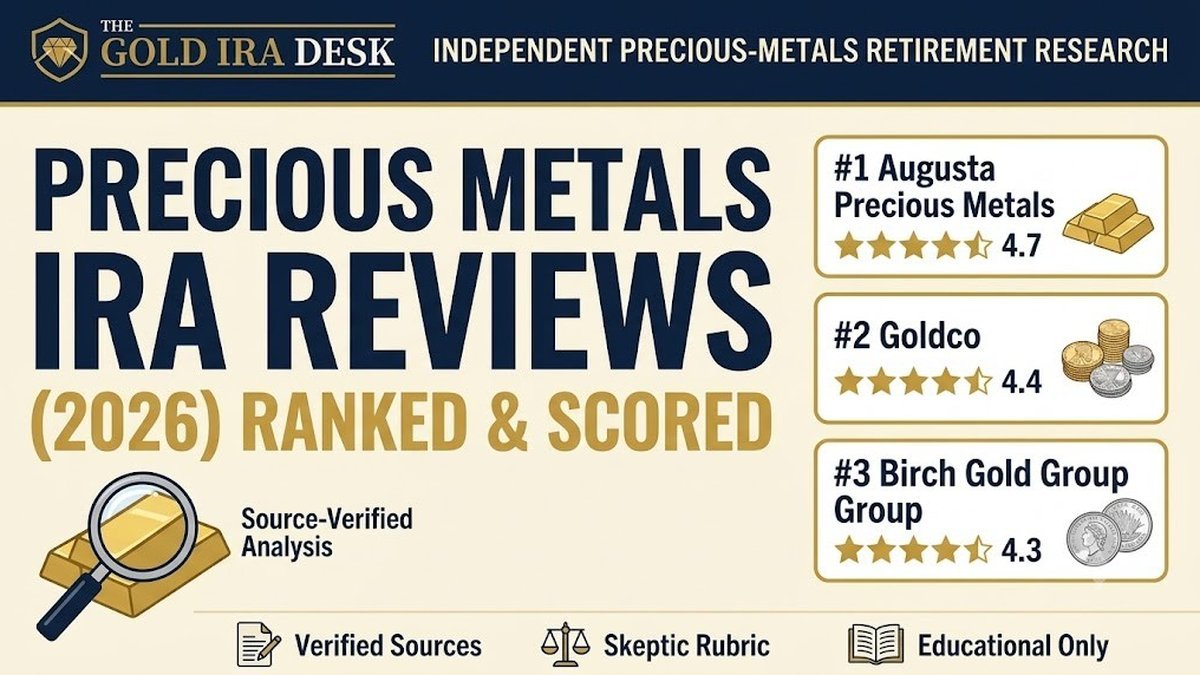
| Augusta Precious Metals | 4.7/5 | 4.9/5, 89% five-star | 4.8/5 | 0 complaints in 3 yrs; accredited since 2015; grade NR during a 2026 re-review |
| Goldco | 4.4/5 | 4.6/5, ~1,806 reviews | 4.4/5, ~1,786 reviews | A+, accredited since December 2011 |
| Birch Gold Group | 4.3/5 | Not re-verified this month | Not re-verified this month | Accredited; fee schedule published in full (per Money 2026) |
| American Hartford Gold | 4.2/5 | Not re-verified this month | Not re-verified this month | A+ profile; AAA BCA |
Three patterns worth reading out of that table rather than past it.
Augusta leads everywhere at once. A 4.9 with a zero percent one-star share on a platform that verifies reviewer identity, a 4.8 on the volume platform, and an empty BBB complaint file across three years of $50,000-minimum transactions. The one open item is the BBB letter grade sitting at NR during a re-review — the full story on that, including the whistleblower allegations that may have prompted it, is in our Augusta complaints breakdown and lawsuit record check.
Goldco’s numbers are good and honestly mixed. The 4.4-to-4.6 band with a visible one-star tail around pricing disputes is what a high-volume sales operation looks like on review platforms. Nothing disqualifying (an A+ BBB record running since 2011 is real), but the gap between the advertised 4.8 and the live 4.4 is a useful calibration for how much marketing rounds up in this industry.
One name conspicuously missing from most roundups: Fidelity, whose IRAs hold physical metals at published percentage fees with no dealer sales layer, reviewed in our Fidelity precious metals IRA breakdown, and absent from affiliate roundups largely because it pays no referral commissions.
Birch and American Hartford compete on structure, not scores. Birch publishes the most complete fee schedule of the four and takes accounts from $5,000–$10,000; American Hartford charges no setup fee and a $75 annual fee under $100,000, with a no-charge buyback commitment. Our best gold IRA companies comparison scores both in detail. We have not re-pulled their platform ratings this month, and rather than quote a stale number as fresh, the table says so.
How to read a precious metals IRA review — including this one
The financial incentive behind gold IRA reviews is uniform: nearly every review site, this one included, earns a commission if you request an information kit through its links. The incentive does not automatically corrupt the content, but it predicts the failure modes. Reviews go bad in recognizable ways:
- Unlinked ratings. A score with no link to the live platform is a quote from marketing. Every number in the table above is either linked or flagged as unverified. (A working example: one dealer’s site claims “thousands of glowing reviews” against a platform count of 42, documented in our American Alternative Assets review.)
- Scare headlines without citations. “Lawsuit,” “scam,” and “exposed” headlines that never cite a court docket or agency release are traffic bait. We dissected how that game works, and who actually has lawsuits in this industry, in the Augusta lawsuit record check. The flip side is equally real: when the record itself is bad, an honest review says so plainly, as ours does for F-rated Colonial Metals Group.
- Silence on the spread. The dealer spread, the gap between a coin’s price and its melt value, is the dominant cost of physical ownership. A review that itemizes $225 in annual fees and never mentions the spread has reviewed the receipt, not the purchase.
- Enthusiasm for “exclusive” coins. Premium and “semi-numismatic” coins carry the widest spreads and star in most of the industry’s enforcement actions, including the CFTC’s $30 million Fisher Capital case. A review steering you toward them is monetizing you twice.
Flip each failure mode and you get the checklist for a trustworthy review: linked live ratings, named criticisms, spread arithmetic, and bullion-first product guidance. We hold smaller dealers to the same standard — our Beverly Hills Precious Metals review shows the checklist against a thin public record, our Sanctuary Metals review against a young one, and our United States Precious Metals review against a 24-year-old one.
Custodian reviews: the half of the account nobody rates
Search “precious metals IRA custodian reviews” and you will find dealer marketing wearing a custodian costume. The distinction matters. Under IRC §408 and 26 CFR §1.408-2(e), IRA assets must be held by a qualified trustee — the custodian. The dealer sells you coins; the custodian administers the account that owns them; the depository vaults the metal. Three parties, three separate things a review can measure.
The custodians you will actually meet, because the major dealers pair with them:
- Equity Trust Company is Augusta’s primary custodian and American Hartford Gold’s as well. Administers the IRA, files the annual IRS reporting, processes rollovers.
- GoldStar Trust Company and Kingdom Trust are the alternative custodian options Augusta offers, per its ConsumerAffairs profile.
- STRATA Trust and Madison Trust are independent self-directed IRA custodians you can bring to a dealer rather than accepting the default.
What a custodian review should actually measure, and what to check before accepting a dealer’s default pick:
- The fee schedule, published. Custodian fees are the $125-a-year line inside your dealer’s quote. Confirm what the custodian itself publishes and whether the dealer’s bundle marks it up.
- Rollover processing. The custodian executes the direct transfer that keeps your rollover inside the rules we cover in the rollover guide. Ask about typical processing time in writing.
- RMD support, in-kind. After the required beginning age, distributions must come out of the account; a custodian that handles in-kind metal distributions cleanly saves you a forced sale.
- Statement quality. Your metal is valued and reported annually; ask to see a sample statement before funding.
None of the custodians above sells metal or sets premiums, which means the sharpest risks in this industry, spreads and steering, live entirely on the dealer side. That is why the scoreboard at the top of this page is about dealers, and why the custodian question, while worth twenty minutes, should not be what your decision turns on.
Affiliate disclosure: if you use a link on this page to request information from a company we review, this site may earn a commission at no cost to you. Every rating above is linked to its platform or flagged as unverified regardless.
Frequently asked questions
Which precious metals IRA company has the best reviews?
Augusta Precious Metals, on the record we can verify as of July 2026: 4.9/5 on ConsumerAffairs with 89 percent five-star reviews, 4.8/5 on TrustPilot, and zero BBB complaints in the three-year window. Goldco follows at 4.6/4.4 with an A+ BBB record since 2011. Check your balance against each company’s minimum before the scores — Augusta requires $50,000.
Can I trust precious metals IRA reviews online?
Only the ones that show their work. Nearly all review sites in this niche, including this one, hold affiliate relationships. Trustworthy reviews link every rating to the live platform, name the criticisms, discuss the dealer spread, and cite courts or agencies when making legal claims. Reviews that quote unlinked scores or push “exclusive” coins are advertisements.
What does a precious metals IRA custodian actually do?
It is the IRS-required trustee under IRC §408: it administers the self-directed IRA, processes rollovers and contributions, files annual reporting, and coordinates with the depository that vaults your metal. Custodians (Equity Trust, GoldStar Trust, Kingdom Trust, STRATA) do not sell coins or set premiums. Dealer conduct and custodian competence are separate questions.
Which review platform should I trust most?
Each has a job. BBB shows escalated complaints and response behavior over a rolling three-year window. ConsumerAffairs verifies reviewer contact information, so its star distribution resists manipulation. TrustPilot offers volume. Cross-platform consistency is the real signal — one strong score can be cultivated; three at once is a pattern.
What are the red flags in a precious metals IRA review?
Unlinked ratings, lawsuit headlines without a docket or agency citation, no mention of the spread, enthusiasm for “exclusive” or “semi-numismatic” coins, and any home-storage pitch — a structure the Tax Court rejected in McNulty v. Commissioner. Each one signals marketing dressed as review.
How do I verify a company myself?
Open its BBB profile (complaint count, accreditation date), its ConsumerAffairs page (one-star percentage), and search its name in the CFTC press room and SEC litigation releases. Then call and ask for the premium over spot and same-day buyback bid on the exact coin, in writing. Twenty minutes, and you will know more than most reviews will tell you.