Beverly Hills Precious Metals Review: The Record Behind the Name
Disclaimer: I am not a financial advisor. This review summarizes public records as of July 2026 for educational purposes. Figures change; verify them at the linked sources and consult a licensed professional before purchasing precious metals or moving retirement funds.
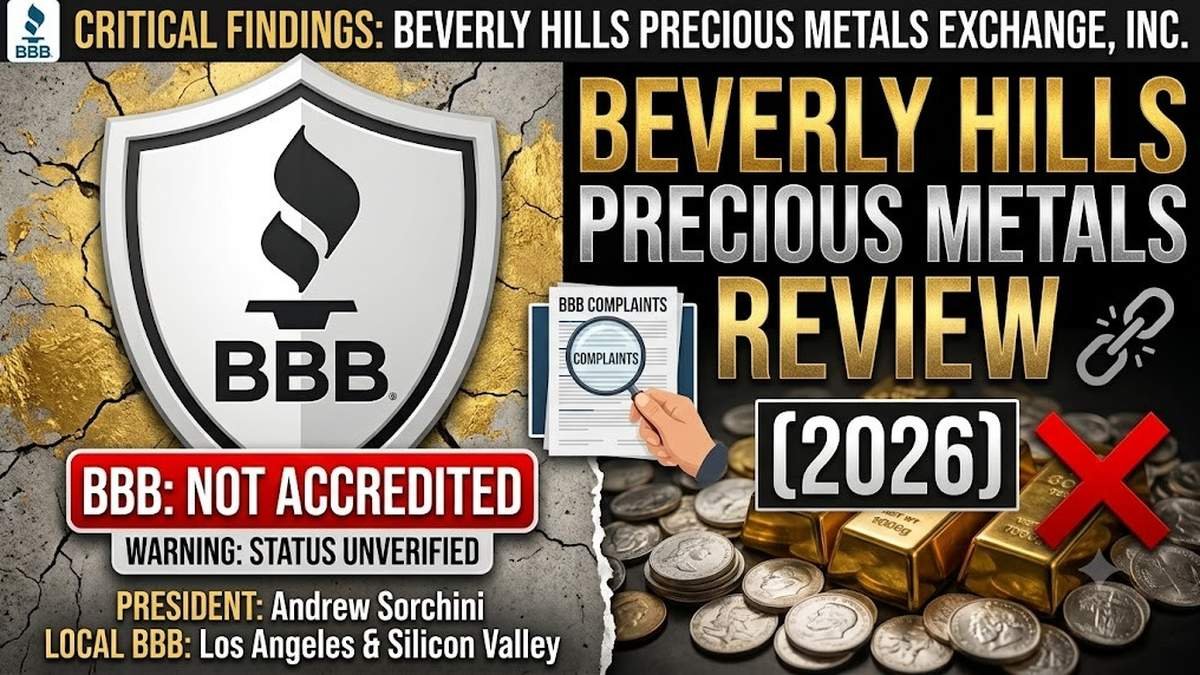
Beverly Hills Precious Metals Exchange, Inc. is a coin and bullion dealer with 15 years in business and an A+ BBB rating, and a public record thin and mixed enough that this review’s verdict comes down to what you cannot verify rather than what you can. Rated 3.6/5: a long-lived dealer with a clean letter grade, no accreditation, no published pricing to check, and complaint commentary aimed at exactly the cost that matters most: premiums.
One housekeeping note first, because it explains why you may have landed here confused. Two different companies dominate this search: Beverly Hills Precious Metals Exchange, the independent dealer reviewed on this page, and Augusta Precious Metals, the national gold IRA firm that happens to be headquartered in Beverly Hills. If you were researching Augusta, our full Augusta review covers it in depth. This page covers the Exchange.
What the public record shows
The verifiable facts, each linked to its source:
| Record | Status | Source |
|---|---|---|
| BBB letter grade | A+ | BBB profile |
| BBB accreditation | Not accredited | BBB profile |
| Years in business | 15 (started November 2010) | BBB profile |
| Published fee schedule | None found | Company materials |
| Court or regulator actions | None found | CFTC and SEC public releases |
Two of those rows deserve translation. An A+ letter grade with no accreditation is a specific combination: the grade reflects factors like time in business and complaint volume, while accreditation is the paid commitment to BBB’s Standards for Trust, including the obligation to respond to every complaint. A non-accredited dealer keeps its grade partly because unanswered complaints against non-accredited businesses affect the file differently. Fifteen years without collapsing into a bad grade is genuinely worth something; it is simply a weaker signal than fifteen years of accredited, answered-complaint history like Augusta’s or Goldco’s. (Even two-year-old Sanctuary Metals chose accreditation in its first year. The commitment is available to any dealer willing to make it.)
The complaint commentary visible on the BBB profile is the more useful signal, because of what it is about: a reviewer describing premiums as far above the metal’s actual content value. One aggrieved customer is an anecdote, not a pattern. But in this industry, premium complaints are the canary. The CFTC’s largest enforcement actions, including the $30 million Fisher Capital case, were built on coins sold at multiples of melt value. A dealer with no published pricing and a premium complaint on file has not done anything wrong on the record; it has just given you nothing to check and one reason to check carefully. (For what the record looks like when that pattern goes further, with unanswered complaints and an F grade, see our Colonial Metals Group review.)
The problem with unpublished everything
Our reviews of the major gold IRA firms lean on their published schedules: Augusta’s fees run $225 a year, disclosed before any transaction; Goldco publishes a $25,000 minimum on its own cost page; Birch Gold publishes its full schedule down to the wire fee. Published numbers can be compared, quoted back, and held against the invoice.
Beverly Hills Precious Metals Exchange publishes no equivalent that we could locate: no fee schedule, no account minimum, no custodian arrangement for IRA purchases. That does not make it dishonest (plenty of small coin dealers operate on quote-by-phone pricing), but it moves the entire burden of verification onto your phone call. For a taxable coin purchase, that may be acceptable friction. For a retirement account, where the metal must sit with a qualified custodian under IRC §408 and every dollar of premium compounds against you for decades, it is a real disadvantage against dealers whose terms are in writing before you dial.
If you do call, the script is short. Ask the premium over spot on the exact coin. Ask the same-day buyback bid on that coin. Ask who the custodian and depository would be for an IRA purchase. Get all three in writing. That script is dealer-agnostic (we recommend it for Augusta and Goldco too), but it does the most work at dealers where nothing is published.
Cash purchase or IRA: which job is this dealer for?
The right way to use a local dealer depends on which of two very different purchases you are making, and conflating them is where buyers get hurt.
(This framework applies to every local coin dealer we review; United States Precious Metals, a 24-year Texas dealer, gets the same treatment.)
A cash coin purchase is a retail transaction. You can walk in, compare the quoted price against the live spot price on your phone, take physical delivery the same day, and walk out owning the metal outright. For this job, a local dealer with 15 years of history is a perfectly reasonable counterparty. The premium is the only number in play, and you can comparison-shop it in an afternoon against two or three other quotes. The metal’s melt value is public; the only private information is the markup, and you can force that into the open by asking.
An IRA purchase is a different machine with more moving parts. The metal must be IRA-eligible under IRC §408(m)(3), held by a qualified custodian, and stored at an approved depository. Taking the coins home is a deemed distribution, a structure the Tax Court rejected in McNulty v. Commissioner. That means an IRA purchase is really three relationships (dealer, custodian, depository), annual fees on two of them, and paperwork that has to be right the first time. Our rollover rules guide walks through the moving parts.
A dealer with no published custodian arrangement can still broker an IRA purchase, but you become the general contractor of the structure. The national IRA firms exist precisely to be that contractor, which is worth something even if you never love their phone-first sales processes.
How it compares with the majors
The honest comparison is short, because it is lopsided. Against the four national firms we track in our best gold IRA companies comparison, Beverly Hills Precious Metals Exchange gives up: published fee schedules (all four majors), published minimums (all four), BBB accreditation with response obligations (all four), zero-complaint or A+ accredited records at scale (Augusta: zero complaints in three years; Goldco: A+ since 2011), and written buyback commitments (Augusta’s zero-commission term, American Hartford’s no-charge commitment).
What it offers against them is proximity and simplicity if you are local and buying coins for cash. That is a legitimate use case, and a 15-year A+ dealer is a reasonable place to price-shop, as one quote among several, with the melt value of the coin open in another tab.
Affiliate disclosure: if you use a link on this page to request information from a company we review, this site may earn a commission at no cost to you. This review’s facts are drawn from the linked public records regardless.
Frequently asked questions
Is Beverly Hills Precious Metals legitimate?
It is a real, long-operating dealer: 15 years in business with an A+ BBB rating as of July 2026, and no court or regulator actions we could locate. It is not BBB accredited, so it carries no obligation to respond to complaints, and its profile’s complaint commentary concerns premiums over metal value. Treat it as legitimate and verify its pricing per coin.
Is Beverly Hills Precious Metals the same as Augusta Precious Metals?
No. Separate companies sharing a city. Augusta Precious Metals is the national gold IRA firm headquartered in Beverly Hills, with BBB accreditation since 2015 and zero complaints in the current three-year window. If Augusta is who you meant to research, start with our full Augusta review.
Does Beverly Hills Precious Metals offer gold IRAs?
Its public materials emphasize direct coin and bullion sales; we found no published IRA fee schedule, minimum, or custodian arrangement. IRAs require a qualified custodian and approved depository under IRC §408. For that structure, compare dealers that publish those arrangements, which all four majors in our comparison do.
What should I check before buying from any coin dealer?
Premium over spot on the exact coin, same-day buyback bid on the same coin, the BBB profile (grade, accreditation, and whether complaints get responses), and, for IRAs, the named custodian and depository. In writing, every time, at every dealer, including the ones we rate highly.