IRA-Eligible Gold: Which Coins and Bars Actually Qualify
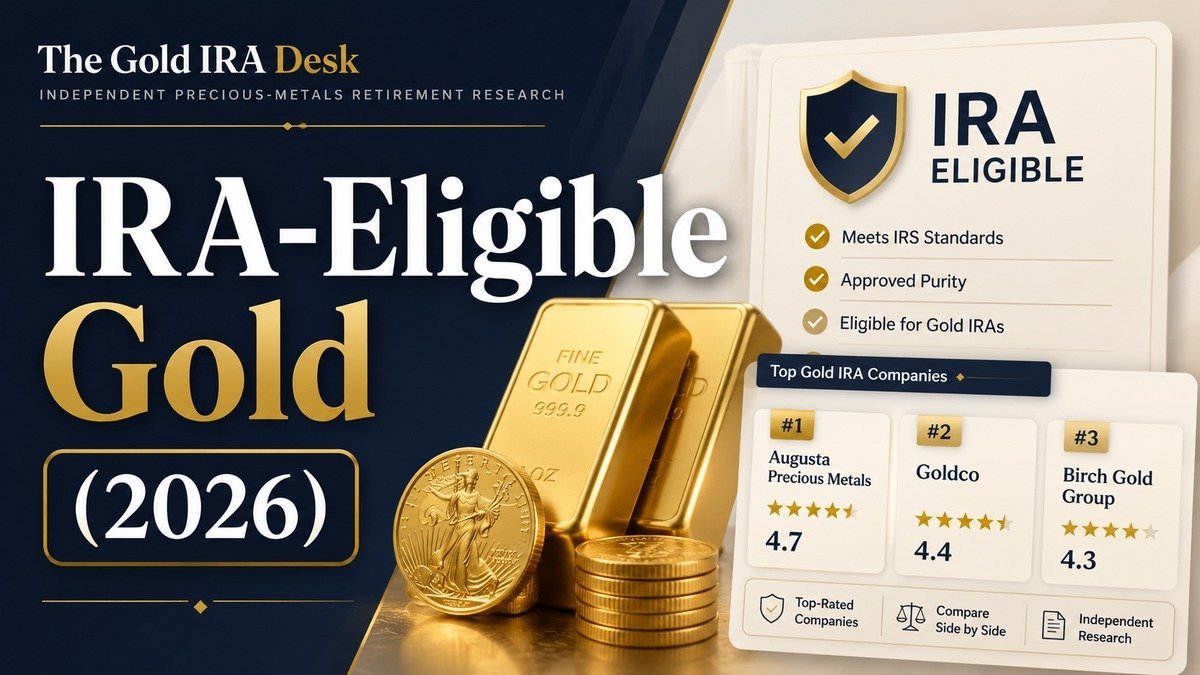
Educational only — not financial advice. What follows is independent research, not personalized investment, tax, or retirement-planning advice. Gold and precious-metals investments carry real risk, including loss of principal, illiquidity, dealer markups, storage costs, and tax penalties for early or improper withdrawals. Past performance does not guarantee future returns. Before opening a Gold IRA, rolling over a 401(k), or buying precious metals, consult a fiduciary advisor and your tax professional. The author is an independent researcher, not a licensed financial advisor, CFP, CFA, or broker-dealer.
The IRS does not publish a list of approved gold coins. There is no registry, no product catalog, no page on irs.gov you can check a coin against. When a dealer hands you a glossy sheet headed “IRA-approved metals,” that sheet is the dealer’s own reading of a two-sentence tax rule, and the quality of the reading varies a great deal from one company to the next.
The rule itself is short. IRC §408(m) says that if an IRA buys a collectible, the purchase counts as a distribution to you of whatever the account paid, and the statute defines “collectible” to include any metal and any coin. Gold is a collectible by default. It becomes eligible only by fitting through one of two narrow exceptions, and everything a dealer can legitimately sell into a Gold IRA fits through one of those two doors.
Affiliate disclosure. Some links on this page (marked as “sponsored” in the link attributes) lead to companies I have an affiliate relationship with. If you open an account or request information through one of these links, I may earn a referral commission at no additional cost to you. My editorial process is independent — I do not change ratings, rankings, or verdicts based on commission rates, and I review companies I have no affiliate relationship with using the same criteria. Full methodology is on my methodology page.
Last updated: July 2026
The rule that makes gold a collectible in the first place
Under IRC §408(m)(1), an IRA’s acquisition of a collectible is treated as a distribution equal to the cost of that collectible. Subsection (m)(2) then lists what counts, and two entries matter: “any metal or gem” and “any stamp or coin.” Read alone, that language bars an IRA from holding gold in any form.
The exceptions in §408(m)(3) are what make Gold IRAs possible at all. They are worth reading as a pair, because dealers tend to quote whichever one flatters the product they are selling.
The two doors: named coins, or fineness
Gold reaches an IRA through exactly one of two provisions. The first names specific coins. The second sets a purity threshold and adds a custody condition.
Door one, §408(m)(3)(A). The term “collectible” excludes any coin that is a gold coin described in paragraphs (7), (8), (9), or (10) of 31 U.S.C. §5112(a), a silver coin described in §5112(e), a platinum coin described in §5112(k), or a coin issued under the laws of any State. Those gold paragraphs describe a fifty-dollar coin containing one troy ounce of fine gold and three smaller denominations at one-half, one-quarter, and one-tenth ounce. That is the American Gold Eagle family, described by specification rather than by name.
Door two, §408(m)(3)(B). The term also excludes gold, silver, platinum, or palladium bullion of a fineness equal to or exceeding the minimum a contract market requires for delivery against a regulated futures contract, provided the bullion is in the physical possession of a trustee. This door carries most of the traffic. Nearly every bar and every foreign bullion coin in a Gold IRA is there because of subsection (B).
Note the asymmetry. Door one has no purity requirement and no custody condition written into it. Door two has both.
What “minimum fineness” actually resolves to
The statute does not state a number. It points at whatever a regulated futures market demands for delivery, which means the answer lives in exchange contract specifications rather than in the tax code. The COMEX metals contracts are the reference in practice.
| Metal | Contract-market delivery standard | Fineness required |
|---|---|---|
| Gold | COMEX gold futures: “shall assay to a minimum of 995 fineness” | 0.995 (99.5%) |
| Silver | COMEX silver futures: “a minimum of 999 fineness” | 0.999 (99.9%) |
| Platinum | NYMEX platinum futures: “a minimum of 99.95% pure” | 0.9995 |
| Palladium | NYMEX palladium futures: “a minimum of 99.95% pure” | 0.9995 |
These are the thresholds every custodian applies. A gold bar at 0.9999, the common refinery standard, clears 0.995 comfortably. A gold product at 0.9167 does not, which brings up the coin that confuses almost everyone.
The Gold Eagle looks ineligible and is not
The American Gold Eagle is 22 karat. Work it out from the statute: §5112(a)(7) specifies a coin weighing 33.931 grams that contains one troy ounce, 31.1035 grams, of fine gold. That is 91.67% pure, far below the 995 threshold in door two.
The Eagle is eligible anyway, because door one does not care about purity. Congress named the coin and stopped there. This single quirk explains why the Gold Eagle is the most heavily promoted IRA product in the industry and why dealers reach for it in conversation: it is unambiguously eligible, it is American, and it carries a wider spread than a plain bar.
The American Gold Buffalo travels the other route. It is authorized under §5112(a)(11), a paragraph that §408(m)(3)(A)(i) does not reference, so it is not eligible as a named coin. It qualifies because it is 99.99% pure bullion under door two. The distinction has no practical effect on whether you can own it, and it is a useful test of whether the person selling to you understands the rule they are citing.
Gold that qualifies
| Product | Fineness | Route to eligibility |
|---|---|---|
| American Gold Eagle (1 oz, 1/2, 1/4, 1/10) | 0.9167 | Named coin, §408(m)(3)(A)(i) via 31 U.S.C. §5112(a)(7)–(10) |
| American Gold Buffalo | 0.9999 | Bullion, §408(m)(3)(B) |
| Canadian Gold Maple Leaf | 0.9999 | Bullion, §408(m)(3)(B) |
| Austrian Gold Philharmonic | 0.9999 | Bullion, §408(m)(3)(B) |
| British Gold Britannia (2013 onward) | 0.9999 | Bullion, §408(m)(3)(B) |
| Australian Gold Kangaroo | 0.9999 | Bullion, §408(m)(3)(B) |
| Gold bars from an accredited refiner | 0.995 or better | Bullion, §408(m)(3)(B) |
Every entry in the bullion rows carries the custody condition attached to door two. Fineness alone does not finish the job.
Gold that does not qualify, and the reason in each case
The exclusions are more instructive than the inclusions, because each one fails for a specific reason rather than by being left off a list.
- South African Krugerrand. 91.67% pure, below the 995 bullion minimum, and not among the coins named in §408(m)(3)(A). It fails both doors. Its 22-karat composition is identical to the Gold Eagle’s, which is the cleanest illustration that eligibility is a legal test rather than a metallurgical one.
- Pre-1933 US gold coins. Saint-Gaudens Double Eagles, Liberty Heads and similar issues are 90% pure and predate the paragraphs §408(m)(3)(A) points to. They are collectibles in the plain sense and in the statutory sense.
- Graded and slabbed coins. A numismatic grade attaches value that has nothing to do with metal content. Custodians generally refuse them, and the premium is the point of the sale rather than an incidental feature of it.
- Jewelry and scrap. No route exists. The metal is not bullion in a deliverable form and no coin provision reaches it.
- Anything held personally. Covered below, and it is the failure mode that costs the most money.
Bars: fineness is necessary, not sufficient
A bar clears the statute at 0.995 or better. Getting a custodian to accept it takes more than that, and the extra requirements come from the delivery standard the statute borrows.
Contract-market delivery is not open to any metal that assays correctly. The COMEX rulebook governs which refiners’ brands are deliverable, and depositories and custodians lean on the same accreditation logic: bars should come from a refiner recognized by the exchange or the London Bullion Market Association, carry a serial number, and arrive with an assay certificate. A 0.9999 bar from an unrecognized refiner may satisfy the letter of the fineness test while being unsellable at a normal spread later, which is a liquidity problem rather than a tax problem, and it is the one that shows up when you go to sell.
Proof coins and where the premium goes
Proof versions of eligible coins are generally accepted. The platinum provision is explicit about it: §5112(k) authorizes the Secretary to mint “platinum bullion coins and proof platinum coins,” and §408(m)(3)(A)(iii) points at that subsection without carving proofs out.
The pricing is the issue. A proof coin sells at a premium over the bullion version that reflects finish and packaging rather than metal, and inside a retirement account you are buying metal exposure. When the account is eventually liquidated, the proof premium is recovered only if the next buyer values it the same way. Proof coins are a recurring feature of high-pressure sales scripts for exactly this reason, and their eligibility is what makes the pitch possible.
Eligible is not the same as sensibly priced
Eligibility tells you the IRS will not treat the purchase as a distribution. It tells you nothing about what you paid. Two products can both clear §408(m)(3) while carrying spreads that differ by ten percentage points or more, and the difference comes out of your account balance on the day of purchase rather than showing up on any fee schedule.
The practical consequence: the eligibility question is settled quickly, usually by the custodian, and then the conversation should move to the spread over spot on the specific product being recommended. Our gold IRA kit walkthrough covers how bonus-metal promotions are funded out of that same spread, and the company comparison sets out where each major dealer’s published costs sit.
Where eligible metal has to live
Door two ends with a condition that is easy to skim past: the bullion must be “in the physical possession of a trustee described under subsection (a).” 26 CFR §1.408-2(e) sets out who can serve as that trustee, which in practice means a bank or an IRS-approved non-bank custodian holding the metal at an approved depository.
Taking personal possession converts eligible metal into a distribution. The Tax Court settled the argument in McNulty v. Commissioner, 157 T.C. No. 10 (2021), where a couple who held IRA gold in a home safe were taxed on the full value. Any pitch involving a home safe, a bank box in your own name, or a checkbook LLC that holds the coins is selling a tax bill. Our rollover rules guide covers the storage requirement alongside the transfer mechanics.
What happens when an IRA buys the wrong thing
The penalty is mechanical. Under §408(m)(1) the account is treated as having distributed to you an amount equal to what it paid for the item. That amount is income in the year of purchase. IRS Publication 590-A adds that you may owe the 10% additional tax on early distributions covered in Publication 590-B, and it restates the exception in plain terms: an IRA can invest in one, one-half, one-quarter, or one-tenth ounce US gold coins, one-ounce silver coins minted by the Treasury, certain platinum coins, and certain gold, silver, palladium, and platinum bullion.
Publication 590-A’s phrasing is worth comparing against a dealer’s product sheet. The IRS describes a narrow set. Sales material tends to describe a wide one.
How to check a product before you buy it
Four questions settle almost every case.
- Is it one of the four American Gold Eagle sizes? If yes, it is eligible under door one and purity is irrelevant.
- If not, is the fineness at least 0.995 for gold? Below that, no route exists, whatever the sales sheet says.
- Who refined or minted it? Sovereign mint or an exchange- or LBMA-recognised refiner, with serial number and assay for bars.
- What is the spread over spot on this specific product, in dollars? This is the only one of the four that costs you money, and it is the only one dealers resist answering in writing.
A custodian will catch a failure on the first three. Nobody catches the fourth on your behalf.
Frequently asked questions
What is IRA eligible gold? IRA-eligible gold is gold that escapes the collectibles rule in IRC §408(m). Gold qualifies one of two ways: it is one of the four American Gold Eagle sizes named in the statute, or it is bullion of at least 995 fineness held in the physical possession of an IRA trustee. Anything else your IRA buys is treated as a distribution of the purchase price.
What fineness does gold have to be for an IRA? At least 995 parts per thousand, which is 99.5% pure. The statute ties the threshold to the minimum fineness a regulated futures contract market requires for delivery, and the COMEX gold contract specifies a minimum of 995 fineness. Silver must be 999, platinum and palladium 9995.
Is the American Gold Eagle IRA eligible even though it is 22 karat? Yes. The Gold Eagle is 91.67% pure, well under the 995 bullion threshold, and it qualifies anyway because Congress named it directly in §408(m)(3)(A)(i). That subsection points to the four gold coins described in 31 U.S.C. §5112(a)(7) through (10).
Is the South African Krugerrand IRA eligible? No. It is 91.67% pure, below the 995 bullion minimum, and it is not among the coins named in §408(m)(3)(A). It fails both routes. The same reasoning excludes pre-1933 US gold coins at 90% purity.
Can I keep IRA-eligible gold at home? No. §408(m)(3)(B) requires bullion to be in the physical possession of a trustee, and 26 CFR §1.408-2(e) sets who can serve as one. The Tax Court applied this in McNulty v. Commissioner (2021), taxing a couple on the full value of IRA metal stored at home.
Does the IRS publish a list of IRA-approved gold products? No. IRC §408(m)(3) sets a test; custodians and dealers apply it to individual products. A dealer calling something IRA-approved is stating a conclusion, not quoting a government list.
What happens if my IRA buys gold that is not eligible? Under §408(m)(1) the purchase is treated as a distribution equal to what the account paid. The amount is taxable income that year, and Publication 590-A notes the 10% additional tax on early distributions may apply if you are under 59 and a half.
Where this leaves you
Eligibility is a settled question with a short answer, and it is not where the money is won or lost. A competent custodian will refuse an ineligible product before it reaches your account. No custodian will refuse an eligible product priced at a 15% markup, because that is a commercial decision and the account holder makes it.
Read the fineness, confirm the route, then spend the rest of your attention on the spread. If you want the eligibility rules and a product list in writing before you speak to anyone, request a free metals guide and compare it against the statute above.
Sources
- 26 U.S.C. §408 — Individual retirement accounts, subsections (m)(1), (m)(2), (m)(3)
- 31 U.S.C. §5112 — Denominations, specifications, and design of coins, subsections (a)(7)–(12), (e), (k)
- IRS Publication 590-A, Investment in Collectibles
- 26 CFR §1.408-2(e), non-bank trustee requirements
- CME Group gold futures contract specifications and the silver, platinum and palladium specifications
- COMEX Rulebook Chapter 113, gold delivery and deliverable brands
- McNulty v. Commissioner, 157 T.C. No. 10 (2021)
